








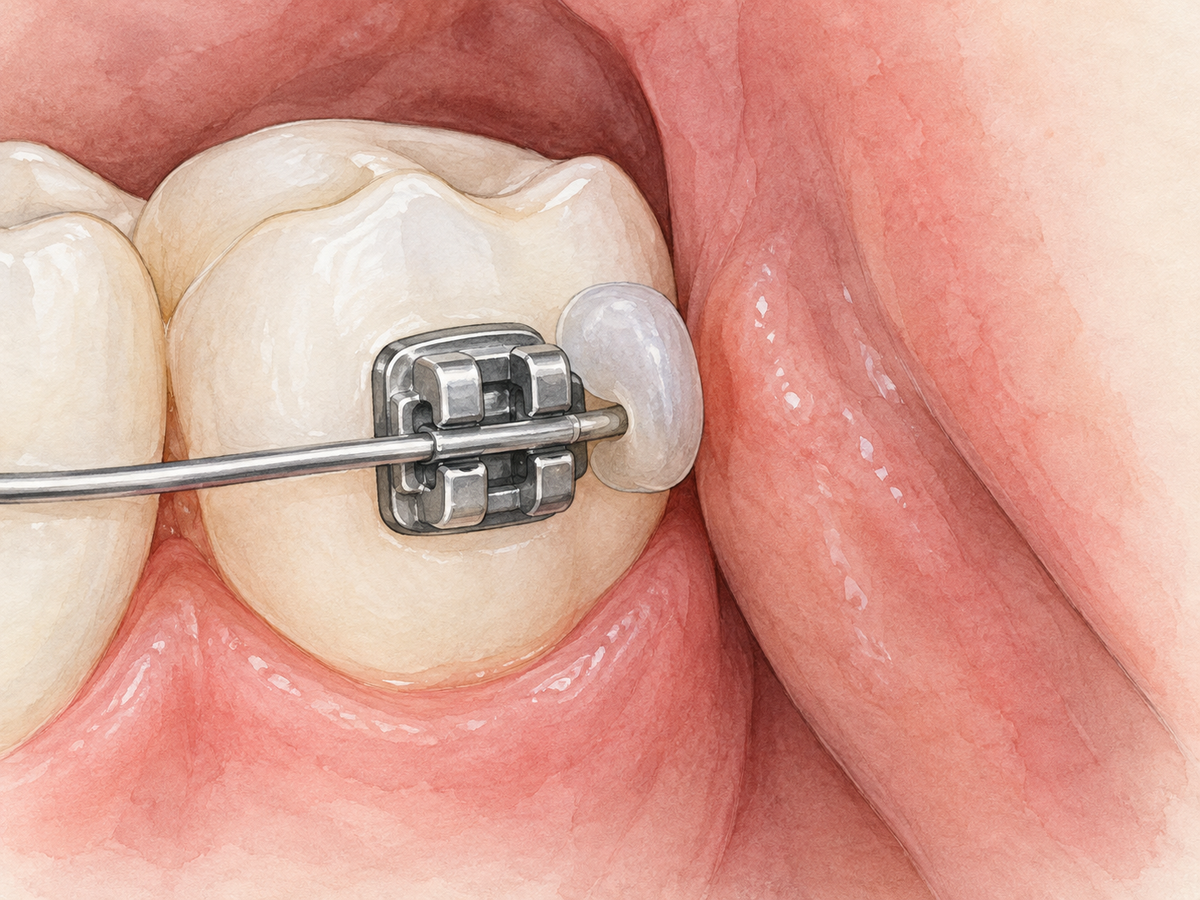
Tooth wax is usually orthodontic wax, a soft store-bought dental wax made for use inside the mouth. You press a small piece over a sharp bracket, wire, denture edge, or chipped tooth edge. It works as a temporary cushion that reduces rubbing, but it does not repair the tooth or appliance. Use only wax labeled for oral use.
Safety rule: Use only wax made for oral use. Remove it before brushing, and avoid eating or sleeping with it if your dentist or the product label says not to.
Tooth Wax or Orthodontic Wax?
“Tooth wax” is a common name for dental wax, often called orthodontic wax or brace wax. It is not a filling, glue, or medicine. The product you want is an over-the-counter dental wax made for the mouth. Check the package label to confirm it says it is safe for oral use.
Candle wax, craft wax, and similar products are not made to sit against your cheeks, lips, or tongue. They may contain dyes, fragrances, or other ingredients that do not belong in the mouth. Do not use them as a substitute for oral wax.
Some oral waxes are medicated. They may contain a numbing ingredient such as benzocaine. These are not the same as plain wax, and you should only use one if a dentist specifically recommends it study on benzocaine-containing wax.
Why It Helps
Tooth wax works as a temporary physical barrier, which simply means a protective layer. The wax covers the sharp spot and shields your cheek, lip, or tongue from rubbing and soreness.
Most orthodontists recommend placing a small amount of utility wax over brackets to reduce soft-tissue rubbing research on bracket protectors. But wax does not heal anything. It cannot move a wire back into place, repair a broken tooth, or make a denture fit better.
| Tooth wax can | Tooth wax cannot |
|---|---|
| Cover a sharp bracket or wire | Repair braces or move a wire |
| Reduce rubbing and soreness for a while | Treat decay or infection |
| Cover a rough denture edge temporarily | Fix poor denture fit |
| Cover a chipped tooth edge briefly | Restore a broken tooth |
Common Uses
The most common reasons people use tooth wax are:
- Braces and poking wires: A bracket or wire can rub a sore spot on the cheek or tongue after an adjustment. Wax covers the sharp part until the orthodontist can fix it. Plain wax may work for mild rubbing, but a sharply poking wire often needs a professional adjustment Wax, Goo or Eze?.
- Denture sore spots: A rough or slipping denture edge can rub the gums. Wax may give brief comfort, but the denture itself usually needs adjustment. Improving the fit of a poor-fitting denture is the key step to stop ongoing tissue trauma denture care review.
- Broken or chipped tooth edges: A sharp edge can scrape the tongue or cheek. Wax can cover it while you arrange dental care.
Wax is a short-term comfort measure, not a treatment for infection, decay, or poor denture fit.
How to Apply It Safely
Follow these steps:
- Wash your hands with soap and water.
- Pinch off a piece about the size of a pea.
- Dry the sharp area with a clean tissue or cotton tip.
- Press and mold the wax over the sharp bracket, wire, denture edge, or tooth edge. Cover only what is needed.
- Remove the wax before brushing. Replace it with a fresh piece as needed.
If the wax will not stay in place, the area may still be wet. Dry it again and use a little more wax, but keep the layer as small as possible.
Avoid eating or sleeping with the wax if your dentist or the product label says not to.
Safety Limits and Common Mistakes
Keep these safety points in mind:
- Do not swallow it. Dental objects can be accidentally swallowed or go down the airway, which may require medical attention guidance on foreign bodies in dental practice. If you have trouble breathing or feel something stuck, get emergency help.
- Do not use it on open sores, cuts, or infected gums. Wax belongs over a sharp spot, not packed into a wound.
- Do not leave the same piece in for days. Old wax can collect bacteria and food debris. Remove and replace it regularly.
- Do not press wax into a broken tooth that is painful, swollen, or shows a pink or red spot. That could be a sign of an exposed or injured nerve, which needs professional dental treatment dental trauma guidance.
- Watch for allergy signs. Allergic reactions in the mouth can cause redness, swelling, peeling, or sores, and can sometimes be linked to materials placed in the mouth AAOM clinical guidance. Stop using the wax and call your dentist if you notice these changes.
- Remove wax before brushing. Then check the area for new soreness, redness, or swelling.
When to Call a Dentist
Wax is a bridge to care, not a substitute. Call a dentist or orthodontist if you have any of these:
- Severe or worsening pain
- Swelling in the gums, face, or jaw
- Fever
- A broken tooth with a pink or red spot, which may mean the nerve inside the tooth is exposed or injured
- A loose tooth or loose denture
- A wire that keeps poking even after using wax
- A mouth sore or ulcer that has not healed after about two weeks
A sore that does not heal after two weeks should be checked by a dentist or doctor clinical information on oral ulcers. For denture problems, repeated sore spots usually mean the denture needs smoothing, relining (adding a new fitting surface), or replacement denture care review. Continuing to use wax alone can hide a fit problem that will keep irritating your mouth.
Think of wax as a cushion, not a cure. It can make the next day or two more comfortable, but it cannot fix a broken tooth, adjust a wire, or correct a loose denture. When the problem keeps coming back or gets worse, call your dental office.
 Best Overall
 Best Value
 Best for Sensitive Teeth
This article has been reviewed by an oral health professional for accuracy. It is intended to provide general educational information and should not be used as a substitute for personalized medical advice, diagnosis, or treatment. If you have questions or concerns about your oral health, please consult a dentist, physician, or other qualified healthcare provider.